Search Box

Links to Culture Cafe Episodes!

Sunday, June 22, 2014

We're Live (And Alive)

It's happening!


We finally recorded the first episode of the Culture Cafe Podcast, and it'll be accessible right here for your listening pleasure. I've opted to put them up through Youtube since that will save me the cost of paying for a hosting site. I think I can still get it on iTunes, making it easier to subscribe and listen to, but I'll have to sort that out later. Here's a link to the episode and then further down are some show notes!

UPDATE: The show is now hosted on Soundcloud and can also be found on iTunes.


Episode 01 - Milk Tea Pt 1

Overview

The debut episode will be at least two parts, possibly even three! We're kicking it off by talking about Mitsuko's accident (being hit by a car) and what it was like being in a hospital for over three weeks.

Notes
 
-Each episode is named after a particular drink, we'll drink it during our our chat and provide thoughts and opinions closer to the end.


-Check out Xanthe's work here http://www.xanthesvoice.com/ and be sure to support her latest work in the upcoming indie game "Bermuda" http://bermuda.invertmouse.com/!

-Check out Mitsuko's X-rays before surgery:


-And post surgery.


Additional Notes

-You can blame me for the music if you don't like it.

-I said "shwap"

Thoughts, suggestions, comments, ideas for future episodes?! 

Send them to CultureCafeCast@gmail.com


-J

Sunday, May 18, 2014

The Culture Cafe Podcast Is Coming Soon!


     So I've been working out the kinks for a while now, but it's happening! I recorded a small preview episode to explain what the podcast is about and why I'm doing it, but to put it succinctly: I'm hoping for the show to be a place where people living in Japan can gather together and swap stories of their lives, from the outrageous and hilarious to the sincere and heartfelt.


Welcome to the Culture Cafe Podcast!


I'll be back with the debut episode soon later next week! Look forward to it!


-J

Wednesday, May 14, 2014

Alien(ated)


  I was honestly planning on writing this just the other day, the same day 
that I found out the original creator of the Alien, H.R Giger, died. 

Rest in piece for your fabulously terrifying work.

            Last weekend I watched Aliens (sequel) for the first time after re-watching Alien as I hadn’t seen it since I was a kid. I try not to let reviews get in the way of my viewing experience regardless of whether or not something was met with acclaim or contempt. That being said, Mitsuko told me this was her favorite of all the Alien films, and I caught a look at the Rotten Tomato score in passing as we were browsing the internet and I was astonished to see that it maintains a mighty 98% which is actually the highest of all the films - the original is a close second at 97%. Well we watched it, and I had some thoughts, so I thought I’d share them here. Before that though, I have to say that I’ve never found myself so far on the opposite end of a spectrum as far as reviews go. I wouldn’t have placed this movie anywhere near the original. To be polite, I thought it was a pretty mediocre B-movie spin on what I consider a Science Fiction classic.
            In order to continue I think it’ll be helpful to introduce the concept of “Scientific Literacy” to this discussion. This is basically an abstract measurement of what it means to be scientifically informed which is sometimes by positing a series of questions about basic concepts such as, atomic structures, DNA, our solar system, the natural world etc, and determining what percentage of people within a given populace can correctly identify true or false statements about them. I think in the movie world of the past there tended to be an overlap between B-movie and Science Fiction as a genre. I’m sure many of us remember or have a good idea of these kinds of films, largely to do with aliens, vaguely science based, and very little actual science behind them. Tales of alien invasions, flying cars, and other such tropes of the Science Fiction genre have long been popular it seems. But counter to this, the idea of science being taught academically has not been.
            At about the turn of the 20th century men such as Charles Eliot and John Dewey propositioned to the National Education Association (of which Charles held a chair in the committee) that it would be in the best interest of students to learn in a manner such that he or she could take said knowledge and make it applicable to their future endeavors. Eliot suggested that an education lacking this was “an education which missed its aim”. That was 1898. Over the course of the years scientific curriculum became standard, and by today studying science - while lacking according to many surveys – is fundamental to our education.
            So what was the point of all that though? My point is that I believe stories in the past (including movies) with even semi-science related concepts at heart were not so easily separated from the B-movie classification. Hard as it may be to accept, we’ve increased general scientific knowledge quite dramatically across the world, and it reflects in the less tacky science based movies of the recent past. So now we get to why I’m even talking about Alien, and its sequel.
            Please watch Alien if you haven’t. It was made in 1979 by Ridley Scott and tells the story of a commercial space ship crew who are asked to investigate a mysterious transmission from an uninhabited planetoid on their way back to Earth. Okay. I’m seriously going to talk about the movie now, so be prepared if you haven’t seen it.
Alien seems to hit upon several themes buried under its initial premise including: Gender Politics, Corporatism, and Technophobia. I suppose we can start with the most obvious one, which involves one of the most memorable and infamous scenes in Hollywood history. The Chestburster (as it appears to be officially referred to as) is iconic in many ways and masterfully blended the idea of Sci-Fi and Horror in one fell swoop. But beyond the surface there’s a great deal to think about in terms of that one scene. Officer Kane (John Hurt) was the first to discover the alien eggs and was attacked by the (also very official sounding) Facehugger. It bursts through his helmet and envelopes his face, as its namesake would suggest. Fast forward, he appears to be okay, only to have whatever embryo the Facehugger left in him to hatch and burst through his chest in an extremely violent manner. What might be read into this? Kane never comes across as a character worthy of this fate, but perhaps Kane is only ever meant to represent the idea of man, who suffers at the fate of what are clearly female issues.

The appendages even come off as being finger-like
 The sexual imagery is hard to escape with how the Facehugger forces its way over his mouth, never allowing him to even as much as scream or otherwise protest this invasion to his body. It clearly plants a seed into his stomach, again forcefully and against his will. The chest bursting sequence has been argued to be a kind of reverse rape and with one look at the alien - phallic in shape – it’s not hard to see why.
It's a girl!

Cheeeeeese
  In addition to this there is the character of Ripley (Sigourney Weaver) who becomes the most capable crewmember, and is the only one to survive. The real world timeframe in America is also important to keep in mind as the movie was released at the tail end of second wave feminism which included advancements such as Roe v. Wade, which established a legal precedent for the right to abortions. There is one more scene involving Ash (Ian Holm) that we can file in this category as well, but we’ll save Ash for later. He’s important too. Regardless, whether or not the filmmakers were attempting to start this kind of conversation, the movie definitely reversed the ideas of birth, rape, and sexual assault onto its former perpetrators.
Then we have Corporatism. I was born in 1987, so I can’t exactly speak for the America population in the 1970s, but with issues such as Watergate, and the Vietnam War, combined with a record high Misery Index (value measuring inflation, and unemployment rates) it wouldn’t be hard to imagine a general consensus of doubt in the government. The American auto industry was also beginning to suffer on the heels of the Oil Crisis in the early 70s. Cars intended to be more cost effective, fuel efficient, and less threatening to the environment, were built as realizations about the unsustainable nature of fossil fuels slowly came to the surface (Fun side note: The first Earth Day was in April 22nd 1970). The film perhaps isn’t speaking to this directly, but appears to include the desperation of this time in a subplot that involves the artificial intelligence MU-TH-UR 6000 on board the Nostromo. Being that Ash is the Science Officer on board the ship, the captain - Dallas (Tom Skerritt), hands over charge of their current mission to him. Ash’s orders are direct and disturbingly succinct. The crew of the Nostromo is not only to bring the specimen back to Earth for potential profits, but the crew is later revealed to be expendable in this charge.

Well, shit.
 Again, it may or not be relevant but real world issues oftentimes provide a useful window with which to look at the problems we fictionalize on the page, or screen. The deadly and desperate mission of ‘suceed at all costs’ for the crew of the Nostromo seems to reflect the notions of distrust in management (Watergate), and the terror of being a human commodity in the face of success (Vietnam).
So that leaves the Technophobia element. Ash becomes a secondary villain midway through the film shortly before we discover that he is an android. He is seemingly unbothered by his quest for scientific knowledge, and even appears to be fascinated to the point of respect with the Facehugger.
 
Magnify.
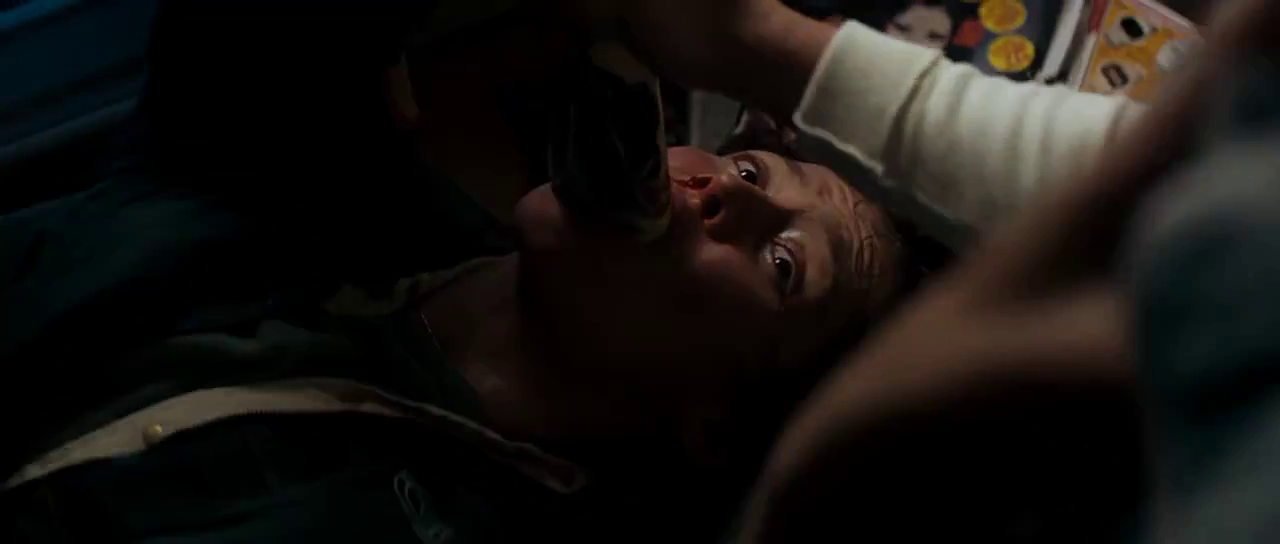
 It is Ash who communicates with Mother – which is also an artificial intelligence – and relays the soul crushing message to Ripley before they engage in a fight that ends with Ash orally violating Ripley with a rolled up magazine.

I think the "men's special interest literature" on the walls there is the strongest argument for interpretation of this scene as a release of sexual frustration
Frustrated Android
 Ash speaks to multiple issues within the movie. The magazine scene could indicate that even though he is not a person, his male identification (and lack of genitals with which to enact his rage) forces him to improvise a way of imposing his authority over Ripley. That aside however, it is interesting to note that much of the duress that comes unto the crew is directly from two non-human entities. At the time of this film, we were merely taking our first steps into the worlds of personal computing. For a few years business model computers had existed but the extent of what consumers could enjoy was limited to things like arcade classics such as Pong, Space Invaders, and Centipede. In 1977 though Apple released the Apple II, which was indeed the first personal computer specifically intended for home consumers. So we have a new era of a brand new concept right around the time this film was released. Perhaps in this case, it was not a fear so much as the initial wonderment associated with what computers might be able to do (or be capable of) in the distant future.
So those are the kinds of things I thought about after finishing Alien again in my post-college-must-overanalyze-everything-from-scratch mindset. I feel however, that regardless of the merit associated with any of this, it is true that the first film inspired more discussion than the sequel. It is Science Fiction in the sense that it deals with things such as aliens, space flight, and androids. It is horror in the sense that the alien wants to impregnate you, kill you, and smile at you as it does so. But it is also thoughtful in that it surrounds these set pieces with literary elements that can be picked apart and thought on.


My impression of Aliens can be summed up via this handy clip. Thanks Youtube!


            My opinion of the sequel certainly seems to be at odds ends with what most people think, but I probably went into it assuming that it was going to be more Science Fiction than Action-Adventure. I believe that Alien is mostly a product of its time whether or not the creators were aware of it. The real world surrounding it shaped the way this story was constructed and conveyed. As for Aliens, I do like Action-Adventure as well, which is when I realized that it would be wrong to lambast it based on what it isn’t. It was a different time, and it's quite simply just a different movie. To quote Einstein, “Everybody is a genius. But if you judge a fish by its ability to climb a tree, it will live its whole life believing that it is stupid.”


Aliens doesn’t climb trees. But it’s not supposed to either.

-J  


Monday, May 12, 2014

Joshua's Corner and the Half Page Column


 Happy Tuesday from Akasaki

Our fish fly

     So there was something I wanted to talk about for a while now. I noticed on my blogger page there was an unpublished draft concerning something called "Joshua's Corner," which is the weekly article I write for my school's webpage. I think in my mind, I forgot that I hadn't published it, but I remembered that I wrote something about it, so it stayed there in digital purgatory for a while.

     Having lapsed all that time, I've become slightly disinterested in talking about why "Joshua's Corner" is a bit more challenging, but in classic bullet point fashion let me outline a few reasons:

  • I can't write too much.
  •  The picture I must submit to go with it needs to be 160x120 pixels in size - for perspective, a screen cap of an iPhone (first generation even) is bigger than this.
  • I later found out it is translated via Google Translate.
     There's also the town article that I write as well. This one has similar limitations, but the audience is my entire town, so I try to write things that are universally appealing and less silly. I write it in English then I hand it over to one of my JTEs who translates it. I could probably take a fair whack at doing the latter myself but I'm happy to turn that over to someone else. Lately it's been a bit hard to find things to write about; being right in the middle of the school year offers little beyond quotidian observations. So for the latest entry I used exactly that and wrote an entry that was very personal and tried to flex the literary muscle a bit more than I have before. I'll probably stick to that method from now on seeing as my JTE enjoyed reading it, and I enjoyed writing it.

Here is the article from last month:


The Most of The Rest

May has arrived, seemingly out of thin air. Just the other day I was walking up the halls towards a class with another teacher and commented on how surprised I was that we have already entered the fifth month of the year. I barely noticed that spring had begun and it would appear that we are already about to leave it behind. In that moment I thought about how long I had been here, and that it would only be three more months before I will have officially been living in Japan for one whole year as an ALT. Sometimes it feels as though all my experiences up to this point have fused into a singular memory of “yesterday,” or some other time in the past. For as much as I try to combat that syndrome by keeping a daily journal I imagine that much of the everyday slips through the cracks. As I reached the 3rd floor I realized that similar to how easily everyday life can pass us by, so too can the duration of my time in Japan, which is just as ephemeral. To that end, I was reminded of how important it was to make the most of my stay. By that time we were at the classroom, and we headed in.

     She said that it reminded her of a Chinese poem she once read about a man who went to sleep and had a dream that lasted his whole life. I filed it under "compliment" but let me know if you feel differently. 


On a completely unrelated note, there is a teacher here who stuffs his tie in his shirt pocket. All the time.


-J

The End of the Beginning

I started a new journal a while back. My first one is full and now shelved. In an oddly ceremonious way (for me at least) I even wrote a sendoff for that volume, which I'll retype in an edited form here for you.

Final Entry

Wednesday April 23rd 4:24 pm

It's been a while. Looking back on the first entries up to this point is bound to be fascinating. I definitely could not have predicted that I would have had as many experiences as have been documented within these pages. My story is both long and new. Still 4 months out from having completed one whole year on this program, there is much left to tell I'm sure. Even when that point comes I'll still be within what I hope is the infancy of my time in Japan. I don't know what to expect and I'm unsure of what I will do but rest assured that I will do my best to preserve it much as I have just done here. 

-Joshua

     I started that journal on July 27th 2013 2:07 am, likely in my own room, definitely after the "Bon Voyage" party. This is what I love about the journal. I feel as though I'm the archaeologist of my own life. With the unearthing of each entry I gain more knowledge as to who this person was, and how the stories recounted on the page tell me little things about him. It's of course possible to read through the journal and just enjoy the entries for what they are; ingesting one at a time following a steady course of events day by day. But it has become far more interesting to wander the nebulous regions of why I chose to write what I wrote; to be a critical thinker of my own thoughts.

Before that starts to sound too pretentious allow me a chance to explain.

     Let's talk about the time stamp. It was something that I started when I kept a journal in Kofu-cho. The Kofu-cho experience (which sounds like a laser light show now) is a huge story for another time, preferably by camp fire with marshmallows and no chocolate, because I'm boring. The short version though is as follows: I was living there with my girlfriend in an attempt to pad out the resume by volunteering at - honestly - whatever school would let me. But back to the time stamp: I'm not sure why I decided to do it. Nevertheless, it carried over into the way that each journal entry opens now. That '2:07 am' says a lot more than the entry does, I think. This is what I mean by studying my own thoughts.
     It's extremely precise for whatever reason, but moreover it seems to indicate that I was deeply intent on carefully detailing every minute (quite literally) of my experience. This may be thought of as nitpicking, but I think the level of excitement I was trying to contain was captured in as little as simply writing down the time. The day I started that journal was the day before I had to fly out of LAX. That was also the day when we had our previously mentioned farewell party. I know I didn't stay late, but what I know from that entry is that I certainly didn't go to bed quickly either. I was up, alert and attentive enough to write down my thoughts in a journal, which in fact requires a lot more concentration than one thinks. There are no backspaces with ink. You can only scratch out what you've written, and I think I admire that aspect of writing with a pen and paper still.
     That was only one example of studying myself, but I'll keep this one short for today. It's fun to write down thoughts and I encourage more people to do it, especially by hand despite how tedious it may first appear. It's a bit like exercising, and if you met me in person you'd know I'm all about that with my one-pack; continuity is easier than starting off.     
     Based on what I read so far, here's a final thought: If I divided the journal entries into binary distinctions of either positive or negative impact, and then plotted those against time on a Cartesian Plane of my existence here in Japan, you'd end up with one hell of a differential equation.

Which is to say that my life is truly a roller coaster here.


-J

Tuesday, April 22, 2014

The Importance of Being (Responsible)

Today is actually about yesterday.

     After having been so utterly frustrated with 5th period class on Monday I took to the internet and left a message as oft senseless and fleeting as those of a skywriter on blustery day. It was only two sentences and it went like this:


That was the worst lesson I've been a part of. 
I have never been so unequivocally disappointed with an entire class


 -Me, in a bad mood. Circa yesterday.


     Here's the story for those of you who want the scoop: My third years are going on a school trip to Kyoto and Nara. In fact, I think everyone's 3rd year students are going on a school around this time of the year, usually right after Golden Week as I hear. In any case, one of my JTEs asked of me a "worksheet" that would help prepare the students for talking with a foreigner. As a brief aside, I hate that word and the way it pops up in my daily life these days, but another post; another day. I set out to make a guideline of sorts that used a mock conversation (minus the English speaker's parts) in a flow that would allow them to politely greet a stranger, ask a few questions, then politely excuse themselves.
     I made a first draft of this that was quickly rejected, as it always is because I never receive explanations of what to do until I do it wrong first. Upon receiving some remarks as to what I should do, I fixed it and left it alone until the class came, about a week later. On the day of the lesson the JTE who requested it, asked to see the worksheet once again. She then showed it to another JTE (also a 3rd year teacher) who produced a worksheet that she had made. I didn't know at the time but this other JTE was coming to the lesson as well. Now it is fairly commonplace for me to be asked to make something, only to have it rejected, or worse, not used at all in the lesson because said JTE actually made a worksheet for herself as if she didn't believe I was going to do what she asked. I already felt like this was going to be one of those situations.
     The three of us move up to the 3rd floor and we start up. From the beginning my students seem completely unenthusiastic, knowing well in advance what I was there for. JTE1 tells me to explain what we were doing that day and I lead off with a speech about my first time in Japan. Let me retell it for you here:

When I first came to Japan in 2007, the first people I talked to were a group of elementary school kids. They were maybe 6 or 7. Maybe older. I can't remember anymore! Anyway, they came up to me and started speaking a bit of English. At the time I had only been studying Japanese for about a year or so, so I couldn't say very much. I introduced myself. I said, 'my name is Joshua' and stuff like that. One of them, a boy, told me that he liked soccer. I remember that part so well. I told him that I liked music. I was so thrilled. That's what made me excited to learn Japanese more. We had a small conversation. I spoke something that they understood, and I could understand them.

I pause.

Now you guys have been studying English a lot longer than I had been studying Japanese at the time. I really hope that you try speaking English if you can, even just a little bit, because it's going to feel amazing. You'll be so excited, and so proud of yourself. So, please, try to talk to someone!

I finish up and we move on.

     Now you might be thinking to yourself, Come on! You expected your students to understand all of that? Of course I did not. I have been reprimanded by JTE1 for speaking Japanese in the classroom - a topic incidentally that I could write a whole book on. I've stopped, because I have trusted JTE1 to translate what I say. It should please to you know that she translated approximately 0% of that entire speech. Her reaction was, "Yeaaah....". This is a supreme point of discontent. I don't mind the FCC blocking the waves so long as the kids are getting the information, but they're not. This happens time and time again, and I'm made to stand there like a jackass for spouting off English that I could translate (poorly no doubt) on my own if I were allowed. I apologize for breaking into tangents quite often, but quite often there are tangents to break into.
     Next, we played English Shiritori,* which they clearly demonstrated was unabashedly lame for kids of their age. Maybe my kids are just too cool for school, but I guess it simply doesn't jive with them anymore. After this, we started the conversation practice. I tried to start the conversation practice. None of the kids paid attention. They all talked over me. When I tried to help translate their practice sentences out loud (because FCC wasn't going to do it) one boy thought it wise to suggest 「トイレへ行きたい」 (I want to go to the bathroom) as the English for each of the sentences I was trying to help them understand. Most of the students were turned in their seats, talking with a neighbor during this futile attempt at what was quickly becoming a disaster. I got through all the practice sentences, just by bull-rushing through them. I didn't care that they weren't listening, or that the JTEs were saying nothing during all of this. They asked for my help and I was going to say my piece before backing down. After I explained the sentences we cut them loose(r?) to come up with some questions that they would ask on their trip. This is when I circled the room. Upon asking, nearly every student said not only were they not going to ask any questions, but that doing so would be 「めんどくさい」which is a Japanese word that means "bothersome" only it's a bit rude. I wanted them to ask me questions. I wanted to be the "foreigner" they encountered in Japan so we could test how much they would be able to talk with someone they met. I had hoped for them to practice their conversations amongst one another. I had hoped for a lot of things.
     This was when they interrupted what apparently was supposed to be a very short segment by me and handed out their worksheet, an activity to interview tourists they meet. I was thoroughly pissed off by this point and I wanted nothing to do with the rest of the day. I was on the tail end of a sore throat, with a pounding headache, and now the taste of a horrible class. They didn't care. 

And by they, I don't just mean the students.

     On all fronts that was pretty upsetting. That was an emotional upset though. I went into this program much like my peers with a smile on my face and hope in my heart. The rate at which the system grinds out the last ounce of moxie from any given ALT seems to run like clockwork. Now that the disillusionment has passed I could try to figure out what I really wanted to do, as well as reevaluate my purpose here. If anything I'm just trying to be a guy that the kids can talk to, and maybe be a person that sparks some curiosity for learning. As much as I hate to think about it in these terms, I might just be a person whose job it is to let them know that foreigners are not all scary. I thought I could do that by talking to them, but many of them rarely wish to converse with me. That might be a bigger issue altogether though.
     Conversation is something that's quite tricky. I can understand why one would want to hand-wave past it. By necessity it's a different breed of communication than the written form, or what one finds buried in their textbook after blowing dust off the cover and cracking it open as though it were a magical tomb of knowledge and early 80's George Lucas. More often than not I see stale conversation in these textbooks and stiff wording like first two sentences of the following:


Apparently he's got three reasons.

     An instance of stiff wording like this came up in one lesson I had a while back with a teacher who is not here anymore. We were getting the students to write a letter (something that should not be done in lieu of conversation practice) about their favorite time of year as well as a few reasons why. I was asked to make the structure exactly like the previous picture. Here's how it read:

"I like winter vacation better than summer vacation. I have three reasons."

     I told my JTE that it sounded a bit rough. I further explained that there was a simpler (and more pleasant) way of saying the same thing, which goes, "I like winter vacation better than summer vacation for three reasons." This was received with a warm reception but I was told that we should just leave it alone for the kids. I did so without paying it much mind, but what I now know to be true is that acts such as those are the seeds for what happened to me yesterday.
     Let's look at these next three pictures for a minute. Each one depicts conversation practice from the current textbook we're using at my school. What do you notice about these three?

There's a lot to be said about these.

Really inadequate direction instructions

A small french fries.

     Now what I noticed is that most of the conversations that occur over the course of these Sunshine textbooks immediately drop into a situation. The set up presumes that someone else has already asked them a question. It doesn't seem designed to give agency to the students for their own conversations. There's no introduction, meeting, or greeting. There's no ice breaker. I've seen many of the "Basic Dialog" sections (which are seriously anything but) include polite phrases such as "Could you" and "Shall we" but never have those popped up as actual grammar points to study. I imagine the writers predicted that the students would absorb this information if it were just dropped into a conversation they were asked to repeat with no knowledge of what it means or how it's used like some form of really cool linguistic osmosis. 


The bold words 
are the current "grammar" point for these particular chapters. I've looked and not once are useful things like "Could you" or "Shall we" covered in any kind of detail.

     The larger point I'm trying to make here is that they don't teach anything that would be useful for starting up a conversation, or at least ways to fill in the holes of a conversation that text printed on paper is not able to cover. And to circle back to my original point, maybe the kids feel like they just don't know where to start in a conversation. I put myself in other people's shoes constantly - I've got average sized feet so I can get a good spread - and I thought about what it must be like for my kids with only these textbooks and the instruction they get from school. When I talk to someone in Japanese, there's a bit of a dance you do to bring up a topic. I'd never just turn around and ask someone if they wanted to join me on a fishing trip. But think about it, is that any different from English? I don't think so. We have dances as well, and someone's dropped the ball on the moves here.
     As you might I imagine I talk about this a lot with friends and family. That being said, I tend to keep most of these ramblings in my brain because I like having friends. One of the things I'm very keen on doing however is making sure I present whatever I have to say within the proper framing. When I'm complaining for example I make sure to not generalize all of Japan or worse, let them leave the conversation thinking such things. I can easily be upset about a lot of stuff here but I have enough sense to know that what I experience is just that, my experience. It's a challenge when we all complain about similar things but us ALTs are in an extremely dangerous position when it comes to cultural representation, which is a two-way street by the way. How we inform other people about Japan is just as important as how Japan receives information about where we're from. As hard as it is, I always try to be responsible with the portrait I'm painting of Japan.


Yesterday made it really fucking hard though.

-J


Wednesday, April 16, 2014

Batabata (And Other Noises)

Today my elementary school visit was canceled.

     This year three of the elementary schools I visit: Yasuda (安田), Isai (以西), and Narumi (成美), have all converged into one location on Narumi's campus and rebranded themselves as Funanoe Elementary School (船上小学校). The change of course means so much news for all three of the schools. For one, they couldn't keep all that staff in one building. Even if the convergence meant they had three school's worth of kids there's certain positions that just don't overlap like the Principal, Vice-Principal, Nurse, and other such staff members. Also, the student population for each of the schools was very small. Yasuda, for example, had a 5th grade class of about 8 students and the around the same for the 6th grade class at Isai. What this means is that many of those classes could be combined, which consequently means that there would be even less positions available after the change. It's a big deal for everyone over there, and I'm not even sure who was able to stay or had to leave. I'll find out the next time I go to Funanoe. Naturally I have a couple of picks in mind if I were building the 2014 Funanoe Dream Team, but we'll see.
     Last week I received a temporary print out of this year's elementary school and kindergarten visits. Today was supposed to be my first visit to Funanoe but I hadn't received any fax or outline on what they wanted me to do. After Kyoutou-sensei asked about next week's kindergarten schedule I informed him that I hadn't heard about what I was doing for Funanoe; he shot straight up in his chair upon realizing this. He placed a phone call, then informed me that they were "batabata," an expression I'd heard before but never looked into. You could probably figure it out without me explaining it it all, but in short it meant they were busy.
     Onomatopoeic expressions do a lot of heavy lifting around here. One has to hand it to them for everything that they manage to say without saying much. Batabata (ばたばた)is not so much a word, but an expression indicated with the sound one makes by saying "batabata". It's a pretty hard concept to explain back home in America because there just really isn't a way of speaking like that. As with many things, there's similarities met with even more nuance. If you had to imagine it though, rather than saying someone was "shot" you instead said someone got "pew pew'd". That's a rough example but it's kind of the idea. Here's a better one for you. Let's pretend you performed a feat of illusion or some other manner of fantastic accomplishment, a fairly camp way of celebrating the climax might be, "tah-dah!". The word doesn't mean anything particular in that sense. It's just a sound to indicate something in our tangible word. Japan's ideophones (onomatopoeic sayings) on the other hand, cover far more abstraction. There's even a "sound" to indicate silence (しいん) which feels like dividing by zero to me. Some of the most well known ones include "doki-doki" (どきどき) -a heartbeat; "kira-kira" (きらきら) - the sound of sparkling; and Gyu (ぎゅ) - which means all kinds of things including: trembling, hugging, or squeezing.
     What makes all of this particularly interesting for me is the way in which language itself encourages these kinds of formations. I'm not a student of Chinese (language), but I remember way back in one of my college classes we discussed Chinese philosophy. One of the essays I wrote on the final for that class (several pages in fact) was how a white horse is not a horse, don't get me started on that by the way. In any case, one of the things we talked about in that class was how the construction of Chinese language allowed for this kind of jejune pedantry. They were playing games with language. In English, imagine I said "Dog Shark". What are you picturing? Chances are it's something that's either mostly one with hints of the other, that is to say: a dog-like shark or indeed a shark-like dog. For a pop culture reference of how this effect works in action check out the following character known as "Catbug" from the web-series "Bravest Warriors":


Part cat, part bug, 100% cute


     Catbug's form factor indicates he's mostly a bug, but the distinctive cat ears and mouth shape point towards that of a cat. He's a cat-like bug. It seems fairly cut and dry, but in our studies we discussed how Chinese language construction allows for something tricky. If written in Chinese the word "Cat-Bug" might not be interpreted as something cat-like or bug-like but as something that is at once a cat and a bug, or belongs to both groups of cat-ness and bug-ness. It's a bit more involved than this, but if you're interested check out the story here. It doesn't seem like a big difference, but it manifested into the form of an ostensibly intellectual school of Chinese thought, so there you go.
     Language is pretty fun and the sound effect based lingo that thrives here in Japan largely stems from the way their language is constructed as well. Japan has a syllabary rather than an alphabet. Since everything is composed of individual characters that represent a singular sound, it would seem that ideophones are far more represented in conversation than America. Manga is a particularly keen way to witness the uses of these effects, and has proven to be a place where they thrive due to their usefulness. In English we rely on words, descriptors, for actions or effects. Things like, "screech," "smash," "creak," and "knock-knock" are all words that become requisitioned to describe the action on the page. Japan has a veritable treasure chest of sound effects which are not exactly words in the sense that they exist to quite literally be the sound for what they describe whereas our onomatopoeia exists to describe what the sound is.

So long story short: they canceled my elementary school visit today.

Batabata,

J